
Below you will find an overview of the most important care services for the year 2025 - broken down by care level and with practical explanations of the individual support services.

People in need of care who are cared for at home by relatives or care services are entitled to financial support depending on their care level:
| Degree of care | Care allowance (monthly) | Long-term care benefits in kind (monthly) | Combination service |
|---|---|---|---|
| 1 | - | - (only via relief amount) | ✗ |
| 2 | 347 € | 796 € | ✓ |
| 3 | 599 € | 1.447 € | ✓ |
| 4 | 800 € | 1.698 € | ✓ |
| 5 | 990 € | 2.095 € | ✓ |
Care level 1 does not receive a care allowance, but is entitled to other benefits (e.g. relief amount, counseling).

Care advice

People in need of care with care levels 2 to 5
Care must take place in the home environment (e.g. own home, with relatives, shared flat)
There must be a private caregiver (e.g. spouse, children, neighbors)
Anyone who uses a care service in addition to family members can combine care allowance with care benefits in kind on a pro rata basis - this is called a combination benefit. I can advise you on how to make the best use of this.
Care degreeCare allowance per month
Care level 2 - 347 €
Care level 3 - 599 €
Care level 4 - 800 €
Care level 5 - 990 €
Care level 1 does not receive a care allowance, but is entitled to other benefits (e.g. relief amount, counseling).
The care allowance is transferred directly to the person in need of care each month by the care insurance fund.
A care consultation in accordance with §37.3 must take place twice a year (PG 2-3) or quarterly (PG 4-5) - I will be happy to do this for you.
In the case of respite care or short-term care, the care allowance continues to be paid on a pro rata basis.
I can help you with the application for care allowance the combination with other services care advice, which is mandatory in order to receive the care allowance permanently.
Long-term care benefits are benefits from the long-term care insurance fund that are used to pay for support from an outpatient care service. They enable people in need of care to be cared for at home - by trained professionals.

People in need of care with care levels 2 to 5
Care is provided by a licensed outpatient care service
Care takes place in the home environment
People in need of care with care level 1 do not receive care benefits in kind, but can use their relief amount (€131/month) for supportive assistance.
Degree of care Care benefits in kind per month
Care level 2 796 €
Care level 3 € 1,497
Care level 4 € 1,859
Care level 5 € 2,299
These amounts are not paid to the person in need of care, but are settled directly by the care service with the care insurance fund.
Body-related care (e.g. washing, dressing)
Nursing care (e.g. help with orientation, communication)
Household help (e.g. shopping, cleaning - to a limited extent)
Assistance with the administration of medication (as prescribed by a doctor)
If relatives help out, care allowance and care benefits in kind can be combined. This is called a combination benefit. The care allowance is paid out on a pro rata basis - depending on how much the care service provides.
I will advise you personally:
Which care services are suitable?
How can the benefit-in-kind amount be used optimally?
What combinations are possible?
I help with application, selection and organization
People in need of care do not necessarily have to choose between care allowance and care benefits in kind. With the combination benefit, both benefits can be used at the same time - flexibly and according to need. This is ideal if relatives and a care service share the care.

If part of the care is provided by relatives (e.g. in the morning or evening)
And an outpatient care service also provides selective support (e.g. with showering or medical tasks)
The care insurance fund pays:
The care benefits in kind directly to the care service (up to the maximum limit)
The care allowance on a pro rata basis - depending on how much of the benefit in kind was used
👉 Example: If 50 % of the care benefit in kind is used up, you will still receive 50 % of the full care allowance.
Care level 2 to 5
Care is partly provided by relatives, partly by a care service
Advice in accordance with § 37.3 SGB XI is still mandatory (semi-annually or quarterly, depending on the care level)
Calculation and planning of the optimum distribution
Application and selection of suitable care services
Support during implementation and advice on site
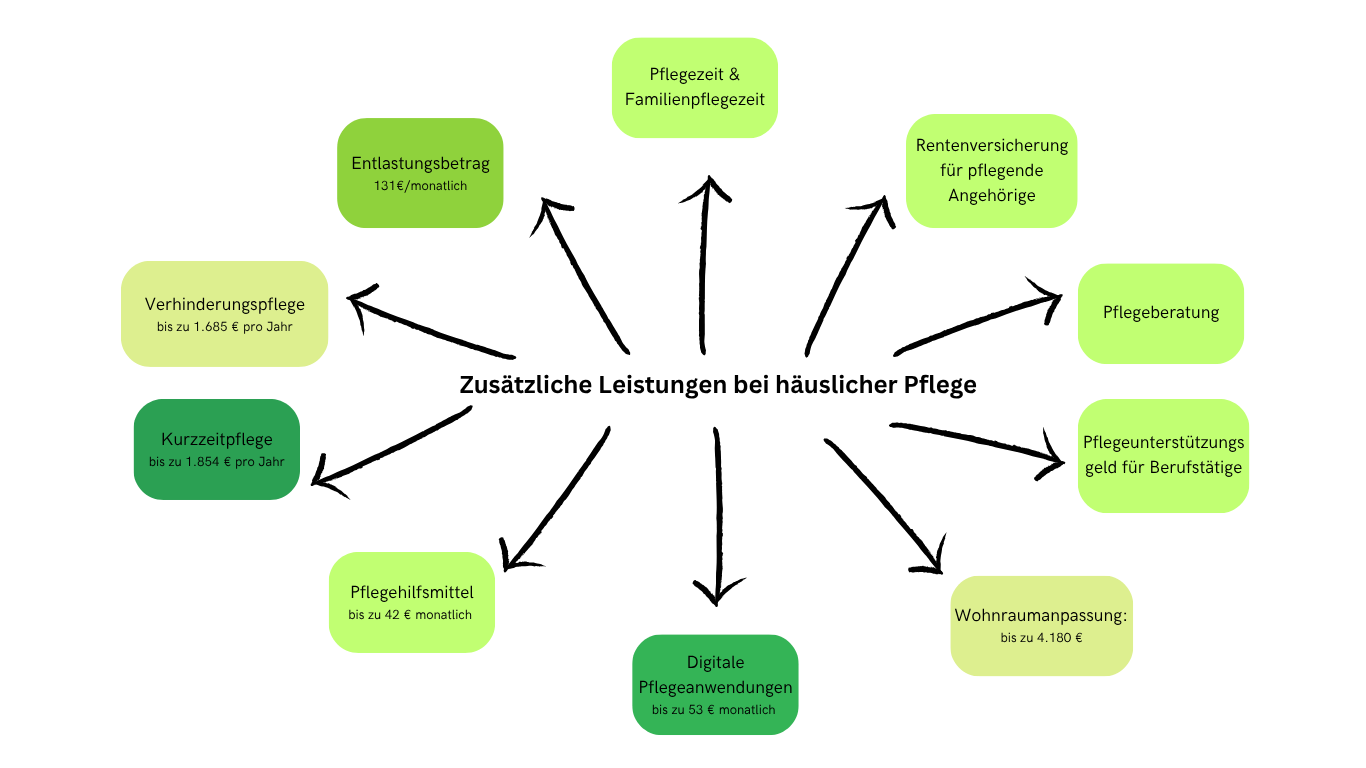
Care is demanding - and no one can be available around the clock.
Preventive care ensures the care of your relatives if you are temporarily unavailable as a caregiver - e.g. due to illness, vacation or other obligations.

Some care situations cannot be managed temporarily at home - for example after a stay in hospital, in crisis situations or if the family carer is absent. In such cases, short-term care comes into play: inpatient accommodation to relieve and bridge the gap.


Care advice Katharina Vogel
Independent & free advice
all about care
Copyright © 2025 by Katharina Vogel. All rights reserved | Design by Dare Solutions
Care advice Katharina Vogel
Independent & free advice
all about care
I support people in need of care and their relatives with competent, impartial advice on all questions relating to care. Together we will find the best solution for your individual situation.
E-Mail: beratung@kv-pflegeleistungen.de
Copyright © 2025 by Katharina Vogel. All rights reserved | Design by Dare Solutions